

SQL在数据查询方面的优势
本指南向数据分析师和科学家展示了 SQL 的核心原则如何构建比通用 Python 脚本更快、更强大、更易于维护的数据管道。
引言:循环往复的隐性成本
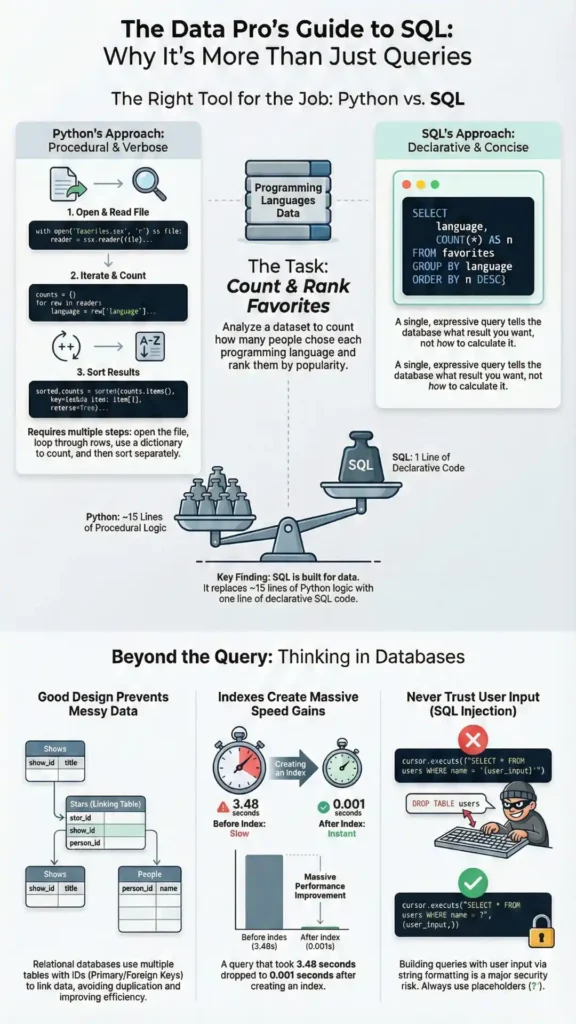
对于许多数据从业者来说,处理新的 CSV 文件时,默认的做法是编写 Python 脚本。我们打开文件,遍历每一行,手动构建计数器或列表来回答看似简单的问题。虽然这种方法可行,但往往会导致代码运行缓慢、脆弱且难以维护。源文件中几列顺序的改变就可能导致整个脚本崩溃。回答稍有不同的问题则意味着需要重写复杂的循环和条件语句。这种命令式的、循序渐进的方法掩盖了一种更强大、更优雅、更高效的数据处理方式。通过采用专门的语言,我们可以更轻松地表达复杂的问题,并将 17 行脆弱的 Python 代码替换为一行声明式的 SQL 代码。
要点一:确保数据采集的稳健性
简单 Python 数据脚本中最常见的漏洞之一是通过数字索引访问 CSV 列,例如: row[1]. This code is fragile because it makes a hard-coded assumption about the data’s structure. If a colleague opens the source spreadsheet and moves the second column to the third position, the script will either crash or, worse, silently produce incorrect results by processing the wrong data.
更稳健的解决方案是使用 Python 的内置函数 csv.DictReader. Instead of treating each row as a list of values, DictReader treats it as a dictionary where the keys are the column headers from the first row of the file. This allows you to access data by its meaningful name (e.g., row['language']), not its arbitrary position. The code will now work correctly even if the columns are reordered, as long as the header names remain the same.
数据科学连接: 这种做法能显著提高数据摄取管道对源文件变更的适应能力。它能减少意外错误,最大限度地减少维护工作,并确保分析结果基于正确的数据列,从而提高整个工作流程的可靠性。
要点二:陈述式思维模式的转变
Python 和 SQL 的一个根本区别在于它们所倡导的编程范式。Python 主要 势在必行——你告诉电脑 如何 逐步获取答案。要从 CSV 文件中统计用户最喜欢的编程语言,Python 方法包括初始化计数器变量、打开文件、遍历每一行,然后使用…… if/elif statements to increment the correct counter. This process, which can take around 17 lines of code, is verbose and details a specific procedure.
相比之下,SQL 则不然。 陈述——你声明 什么 您只需提供想要的答案,数据库引擎就会找出获取该答案的最有效方法。同样的计数任务在 SQL 中只需一条语句即可完成: SELECT language, COUNT(*) FROM favorites GROUP BY language;. This query doesn’t specify loops or conditionals; it simply states the desired result: a count of entries for each language. This shift from describing a process to describing an outcome is a powerful mental leap.
数据科学连接: 声明式思维使分析师能够更直接地表达复杂的数据问题,并减少逻辑错误的可能性。与其构建复杂的程序循环,不如专注于定义所需数据,从而编写出更清晰、更易读、更准确的查询。
“……我们似乎花了大量时间来构建这个,但如果能简化代码就好了……如果能快速回答这个问题就太好了……”——哈佛 CS50x 2025(YouTube)——讲座:SQL
要点三:良好的数据结构并非偶然
数据结构会极大地影响您正确高效地分析数据的能力。一个常见的错误,例如电视剧《办公室》的电子表格,就是对相关数据的存储方式不当。一种糟糕的设计是为每位明星添加一列(star1, star2, etc.), which is inflexible and doesn’t scale. Another flawed approach is to have a row for each star, repeating the show’s title (“The Office”) over and over again, creating massive data redundancy.
解决方案是一个核心数据库概念,称为 归一化与其使用一张杂乱的表格,不如将数据拆分成多个表格,分别对应不同的实体。例如,您可以创建一个…… shows table for TV shows and a people table for actors. You then create a third “join table,” stars, that links them together using their unique IDs (show_id 和 person_id).
这种设计通过将诸如“The Office”之类的长而可变长度的文本字符串替换为小的、固定大小的整数(例如,32 位或 64 位 ID),从而消除了冗余。这种方法可以显著节省空间并提高性能。
数据科学连接: 规范化为数据清洗和结构化提供了一种强大的思维模型。识别并修复混乱数据集(例如电子表格)中的冗余数据有助于防止分析错误,并确保聚合和连接操作产生正确的结果。这是为可靠分析准备数据的基础步骤。
要点四:一行代码即可解决性能问题
查询速度慢是数据分析的一大瓶颈,尤其是在处理具有复杂关系的大型数据集时。例如,在讲座中,一个连接三个表以查找史蒂夫·卡瑞尔所有电视节目的查询耗时“令人恼火地长”的 3.483 秒。造成这种延迟的原因是,在没有指导的情况下,数据库执行的是线性搜索——检查表中的每一行以查找匹配项。
解决方案是创建一个 INDEX on the column being searched. An index is a special data structure, much like the index at the back of a book, that allows the database to find specific rows almost instantly without scanning the entire table. By running a command like CREATE INDEX name_index ON people (name), you instruct the database to build an efficient lookup structure (typically a B-tree). In the lecture’s example, creating two indexes reduced a query for Steve Carell’s shows from 0.215 seconds to just 0.001 seconds—a massive performance gain.
缺点是索引会占用更多存储空间,并且可能会稍微减慢写入操作的速度(INSERT, UPDATE, DELETE), as the index must also be updated. However, for read-heavy analytical workloads, the benefit to SELECT speed is almost always worth it.
数据科学连接: 了解索引为数据从业者提供了一种简单高效的工具,可以帮助他们解决性能瓶颈。当面对大型数据集上的缓慢查询时,在筛选后的列上创建索引通常是首要且最有效的优化步骤。
要点五:停止盲目信任用户输入
通过将用户输入直接插入字符串来构建查询(例如使用 Python 的 f-string),会造成一种严重的安全漏洞,称为 SQL 注入攻击。当恶意用户提供的输入被作为 SQL 命令的一部分执行时,就会发生这种情况。
一个经典的例子涉及登录表单。如果代码构建了一个类似这样的查询 f"SELECT * FROM users WHERE username = '{username}'", a user could enter a username of admin' --. The single quote closes the string, and the -- starts a SQL comment, causing the rest of the original query (including the password check) to be ignored. The database is tricked into logging the user in as ‘admin’ without a valid password. This is famously alluded to in the “Little Bobby Tables” webcomic.
解决方案是 总是 使用 参数化查询与其使用 f 字符串,不如使用占位符(例如 ?) in your SQL string. You then provide the user’s input as a separate argument. The database library ensures that the input is treated strictly as data and never as executable code, completely preventing SQL injection attacks.
数据科学连接: 对于任何构建交互式数据应用程序、仪表板或任何基于用户提供的筛选条件或输入查询数据库的工具而言,这都是一项至关重要的安全实践。未能对查询进行参数化会将您的数据和系统暴露于重大风险之中。
今天申请什么
- 在 Python 中读取 CSV 文件时,请使用
csv.DictReaderinstead of accessing columns by number. - 在编写用于聚合数据的 Python 循环之前,请先问自己:“这是否可以是一个单独的数据?”
GROUP BYquery in SQL?” - 如果在电子表格中看到相同的文本值重复出现多次,请考虑将数据拆分为两个通过唯一 ID 链接的表格。
- 如果一个
SELECTquery with aWHEREclause is slow, create anINDEXon the column(s) in theWHEREclause. - 切勿使用 f 字符串或字符串拼接将用户输入添加到 SQL 查询中。务必使用占位符。
关闭
虽然使用像 Python 这样的通用编程语言处理所有任务很方便,但 CS50 的这节课表明,计算机科学的基本概念能够为数据工作带来强大的实用优势。这节课只是一个系列讲座的一部分,该系列讲座全面展示了计算机基础知识如何直接提升数据分析的质量和效率。通过运用 SQL 的声明式特性、合理的数据建模原则和性能优势,数据从业者可以编写出不仅速度更快,而且更健壮、更易于理解的代码。
在 Python 中,有哪些常规的数据处理任务可以用一个简单的 声明式 SQL 查询来代替?